About the project
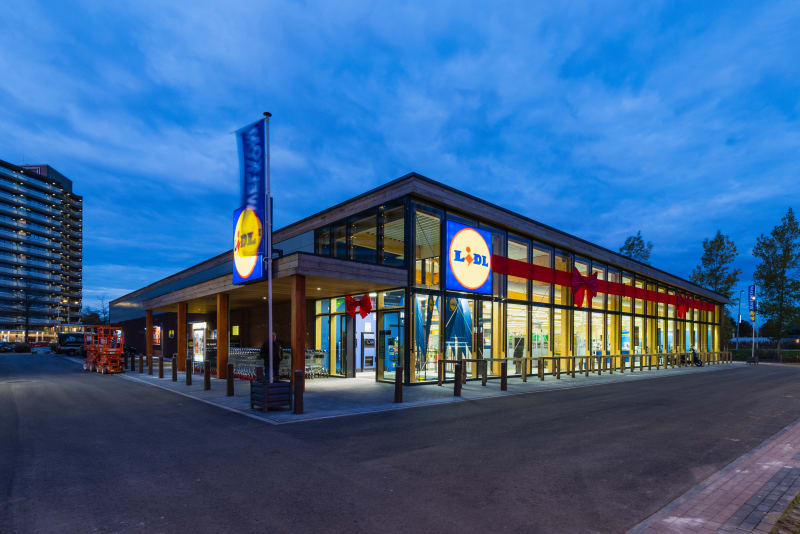
This project enables the long-term storage of carbon that has been removed from the atmosphere through photosynthesis and locked away in the timber structure of the new Lidl supermarket in Capelle aan den IJssel. The design is based on the principle of material minimisation: only a limited set of materials with the lowest possible emissions during production and processing was selected, with the main load-bearing structure built from timber.
By prioritising a wooden structural frame over conventional materials like steel and concrete, the project replaces more carbon-intensive alternatives and ensures that the carbon captured by trees during growth remains locked within the building for decades. The store itself spans 2,523 m² and was developed following Lidl's standardised national building specification, adapted here to incorporate a timber-based design.
In addition to the structural use of timber, the site applies olivine, a natural rock that binds CO₂ from the air through weathering, contributing further carbon compensation alongside the storage achieved through biobased building materials. The construction also incorporates circular design choices: demountable wood connections, a detachable roof covering, and a dry-stacked façade system (ClickBrick), all of which allow materials to be reused in future renovations or demolition.
By embedding carbon in a durable timber structure while minimising material use and emissions, this project contributes to a built environment that actively supports climate goals and demonstrates how a high-traffic commercial building can also function as a long-term carbon sink.
About the project owner
Lidl Nederland is part of the Schwarz Group and operates according to a sustainability strategy built around six pillars: protecting the climate, conserving resources, respecting biodiversity, engaging in dialogue, fair trading practices including human rights policy, and promoting health across the chain and with stakeholders. As a discount retailer, Lidl frames efficiency and sustainability as closely linked: it generates 100% of its own green energy through solar panels on store roofs, distribution centres and a solar field, and reuses more than 95% of its residual material streams.
This store, known internally as Lidl Zero Capelle, is the third in Lidl's "Zero" concept, following earlier projects in Woerden and Almere. The starting points for these stores are a low environmental impact and a fully energy-neutral ("nul-op-de-meter") result. CO₂ emissions during construction are minimised partly by building extensively with timber and giving old materials a second life, with any remaining emissions compensated through olivine applied on the site's own car park. For its design, the store received an environmental performance score (GPR) of 8.5 — the highest ever achieved in Dutch supermarket construction.
By choosing a timber main structure instead of its standard concept, Lidl ensures that carbon absorbed by trees during growth is stored within the building for as long as the structure stands — one concrete expression of a sustainability strategy the company describes as fully integrated into its business strategy, with international ambitions it pushes further still in the Dutch market.